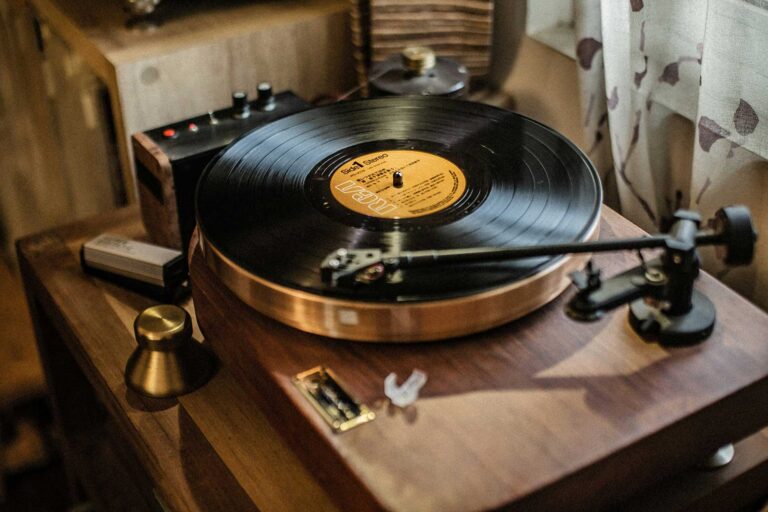
Getting your phono cartridge properly aligned can make a bigger difference than you might expect. A good cartridge alignment protractor helps position the stylus correctly in relation to the record groove, reducing tracking error and helping your cartridge perform as intended.
There are plenty of options available, from simple printable templates to dedicated cartridge alignment tools made from acrylic or metal. Some are designed around specific tonearms, while others use popular alignment geometries such as Baerwald, Löfgren and Stevenson.
What Is a Cartridge Alignment Protractor?
A cartridge alignment protractor is a setup tool used to position a phono cartridge correctly on a tonearm.
When you install a cartridge, the stylus needs to sit in the correct position relative to the tonearm pivot and turntable spindle. The cartridge also needs to be rotated to the correct angle.
A protractor gives you reference points that allow you to check these measurements visually.
Most two-point protractors use two null points. You adjust the cartridge until the stylus lines up correctly at both points.
This helps minimize tracking error as the stylus moves across the record.
For many turntable owners, a cartridge alignment protractor is one of the most useful low-cost accessories for cartridge setup.
Best Cartridge Alignment Protractors and Tools
If you’re setting up a new cartridge or upgrading your turntable, these are some of the best cartridge alignment tools and protractors to consider.
Mobile Fidelity Geo-Disc
The Mobile Fidelity Geo-Disc is one of the better-known cartridge alignment tools for vinyl enthusiasts. Its design makes it relatively easy to check cartridge position without dealing with a complicated setup.
It is a good option if you want a reusable tool rather than printing a new template every time you install a cartridge.
Best for: Beginners and vinyl listeners who want a simple alignment tool.
Get Mobile Fidelity Geo-Disc on Amazon.
Pro-Ject Align It DS3
The Pro-Ject Align It DS3 is a more advanced cartridge alignment tool designed for users who regularly work on cartridge setup.
A dedicated tool can be particularly useful if you change cartridges frequently because you can keep it with your turntable setup instead of relying on printed templates.
Best for: Vinyl enthusiasts who frequently install or change cartridges.
Get Pro-Ject Align It DS3 on Amazon.
Audio-Technica AT-CAP1
The Audio-Technica AT-CAP1 is a straightforward cartridge alignment protractor designed for cartridge setup.
It is compact, easy to store and useful when you want a dedicated alignment reference instead of a paper template.
For Audio-Technica cartridge owners, it can be a convenient addition to a basic turntable setup.
Best for: Audio-Technica cartridge owners and straightforward cartridge alignment.
Get Audio-Technica AT-CAP1 on Amazon.
Audio-Technica AT-VTAZ1
The AT-VTAZ1 is a little different from a basic cartridge alignment protractor because it can also be used when checking tonearm height and cartridge azimuth.
That makes it more interesting for enthusiasts who want to go beyond basic overhang and offset-angle adjustment.
Best for: More advanced turntable setup.
Get Audio-Technica AT-VTAZ1 on Amazon.
Ortofon Cartridge Alignment Protractor
An Ortofon cartridge alignment protractor helps position an Ortofon cartridge correctly in the headshell by checking stylus overhang and cartridge angle.
It’s useful for cartridges such as the Ortofon 2M Red, Blue, Bronze and Black, but make sure the protractor matches your tonearm geometry. A universal Baerwald or Stevenson cartridge alignment protractor may also work depending on your tonearm.
Get Ortofon cartridge alignment protractor on Amazon.
Rega Protractor: A Useful Option for Rega Turntables
If you own a Rega turntable, a Rega protractor can make cartridge setup much easier.
Rega tonearms have their own geometry, so you should not automatically assume that every universal protractor will give you the correct setup.
A Rega protractor is designed around the geometry of compatible Rega tonearms. This makes it particularly useful when installing a cartridge on models such as the Planar 1, Planar 2, Planar 3 or other Rega turntables.
If you’re using a Rega turntable, check the tonearm specifications before choosing an alignment template.
You can also read our guide to the best Rega turntable upgrades if you’re planning a bigger upgrade.
Cartridge Alignment Protractor Printable Options
You don’t always need to buy a physical alignment tool. A cartridge alignment protractor printable template can be a very inexpensive way to set up your cartridge, especially if you’re installing a new phono cartridge or checking your existing alignment.
Several websites offer free downloadable cartridge alignment protractors, including universal two-point templates and tonearm-specific designs. Here are a few worth checking out.
Baerwald vs Stevenson Alignment Protractor
One of the most common questions when choosing a cartridge alignment protractor is which alignment geometry to use.
Baerwald, also known as Löfgren A, is a popular choice because it spreads tracking error across the record using two calculated null points.
Stevenson uses a different set of null points and places one closer to the inner grooves. This can be useful when you want to pay particular attention to tracking near the end of a record.
Neither geometry should simply be treated as a universal setting for every turntable.
Your tonearm’s effective length, pivot-to-spindle distance and manufacturer’s recommended geometry all matter.
What Is a Stevenson Alignment Protractor?
A Stevenson alignment protractor is a cartridge setup template based on the Stevenson alignment geometry.
Like other alignment systems, it gives you reference points that allow you to adjust the cartridge’s overhang and offset angle.
The main difference is where the null points are located.
A Stevenson alignment protractor places the inner null point relatively close to the end of the playable record area. This means the alignment gives particular attention to the inner grooves.
This can be useful for listeners who regularly play records with music extending close to the run-out area.
If your tonearm or cartridge setup recommends Stevenson geometry, use a compatible Stevenson alignment protractor rather than simply choosing Baerwald because it is more commonly mentioned online.
2-Point Cartridge Alignment Protractor
The two-point design is probably the easiest type of cartridge alignment protractor to understand.
You place the protractor over the turntable spindle and position the stylus at the first null point. You then check the second point.
If the cartridge doesn’t line up at both points, you adjust its position and angle.
The process can take a few attempts, especially when you’re installing a cartridge for the first time.
Take your time and don’t fully tighten the cartridge screws until you’re happy with the alignment.
Arc Protractors
An arc protractor works slightly differently.
Instead of simply checking two individual points, the stylus follows an arc across the protractor.
If the stylus remains on the correct arc while the cartridge is aligned with the reference markings, you can confirm that the overhang and alignment are correct for the selected geometry.
The catch is that an arc protractor needs accurate tonearm measurements.
A universal arc template isn’t automatically suitable for every tonearm.
This is why a basic two-point cartridge alignment protractor can be easier for beginners.
How to Use a Cartridge Alignment Tool
Start by securing the turntable so the platter doesn’t rotate while you’re working.
Install the cartridge into the headshell, but leave the mounting screws slightly loose so you can move the cartridge.
Place your cartridge alignment tool on the turntable spindle and position it according to the manufacturer’s instructions.
Move the cartridge forward or backward until the stylus reaches the correct overhang position.
Next, adjust the cartridge’s rotation so it follows the alignment lines.
Check both null points if you’re using a two-point protractor.
You may need to repeat the process several times. That’s normal.
Once the cartridge is correctly aligned, carefully tighten the mounting screws and check the alignment again. Tightening the screws can sometimes move the cartridge slightly.
After the alignment is finished, set the tracking force and anti-skate according to the cartridge manufacturer’s specifications.
Don't Forget Tracking Force
Cartridge alignment is only one part of a proper turntable setup. After using your cartridge alignment tool, you’ll also want to set the correct tracking force. A digital stylus force gauge makes this much easier than relying only on the numbers printed on the tonearm counterweight.
For example, the Audio-Technica AT-VM95E has a recommended tracking force of 2.0 g. If you’re using another cartridge, follow its manufacturer’s recommended setting.
You can also check our guide to the best digital stylus force gauges for turntables for more information.
Even with a properly aligned cartridge, you may still hear pops and crackles from your records. Dust, static, scratches, worn records and improper cleaning can all contribute to unwanted vinyl noise.
If your cartridge is aligned correctly but your records still sound noisy, check out our guide on why your vinyl records crackle and how to fix it. It covers the common causes of vinyl crackle and practical ways to reduce unwanted noise.
Which Cartridge Alignment Tool Should You Buy?
The right cartridge alignment tool depends on your turntable and tonearm.
A basic two-point cartridge alignment protractor is a good starting point for most vinyl listeners. It is inexpensive, reusable and relatively easy to understand.
A cartridge alignment protractor printable template is another good option if you want to keep costs down.
Rega owners should look for a compatible Rega protractor, while users who specifically want Stevenson geometry can use a Stevenson alignment protractor designed for their tonearm measurements.
For enthusiasts who regularly change cartridges, a dedicated acrylic or metal alignment tool can make repeated cartridge setup much easier.
The most important thing isn’t choosing the most expensive tool. It’s choosing a protractor that matches your tonearm geometry and using it carefully.
Final Thoughts
A properly aligned cartridge can help reduce tracking error and give your stylus the best chance of following the record groove correctly.
For most people, a good cartridge alignment protractor is all that’s needed. You can even use a cartridge alignment protractor printable template if it is printed at the correct scale.
Rega owners can look for a compatible Rega protractor, while vinyl enthusiasts interested in inner-groove performance may want to look at a Stevenson alignment protractor.
Once you have the correct geometry, the actual setup doesn’t need to be complicated. Take your time, check both alignment points and recheck everything after tightening the cartridge screws.
A small alignment tool can save you a lot of frustration and potentially make your next vinyl listening session sound that much better.
Disclaimer: This article contains affiliate links. If you purchase a product through one of these links, ShutterGroove may earn a small commission at no extra cost to you. These commissions help support the site and keep our content free to read.